The Threading Truth: Why 16g Ends Won’t Fit Your 14g Jewelry

So, you’ve finally found it. The mystical, opal-encrusted, "I-need-this-or-I’ll-die" decorative end for your piercing. You’ve been dreaming of curating the perfect ear project or upgrading your industrial barbell for weeks. It arrives in the mail, you carefully unscrew your current jewelry, and... spin. Nothing. No resistance, no click, just a tiny piece of metal sliding uselessly over a post like a sad, tiny hula hoop.
Welcome to the confusing world of body jewelry threading. It’s the ultimate "it’s not you, it’s the math" moment.
If you’ve ever wondered why your 16g ends won’t fit your 14g jewelry, or why the hell we’re talking about "0.9mm" and "1.2mm" like we’re in a high-stakes engineering lab, pull up a chair. We’re about to dive into the technical heart of titanium piercing jewelry so you never have to deal with the heartbreak of incompatible adornments again.
GAUGE VS. THREAD: THE CRITICAL DISTINCTION
Before we get into the nitty-gritty of why things don’t fit, we need to clear up the most common misconception in the piercing world: Gauge is not the same as thread size.
When we talk about 16g vs 14g, we are talking about the Gauge. This refers to the thickness of the bar: the part that actually sits inside your body.
- 16g (1.2mm) is the standard thickness for most cartilage, helix, and lobe piercings.
- 14g (1.6mm) is the thicker standard used for navels, industrials, and some nipple or tongue piercings.
However, when you buy an internally threaded piece, you aren't just buying a bar; you're buying a mechanical system. The "thread" is the tiny screw attached to the decorative end that twists into the hollow post.
The industry standard is a bit of a curveball:
- 16g and 18g jewelry almost always use a 0.9mm thread.
- 14g and 12g jewelry almost always use a 1.2mm thread.
Think of it like trying to use a AA battery in a slot designed for a D battery. One is simply too small to make the connection, even if they’re both technically "batteries."

THE 0.9MM VS. 1.2MM DIVIDE: WHY THEY DON'T PLAY NICE
The math of body jewelry compatibility is unforgiving. If you have a 14g post, that post has a hollow center with a hole precisely machined to 1.2mm in diameter.
If you try to screw a 16g decorative end (which has a 0.9mm thread) into that 14g post, the thread is literally too thin to catch the "teeth" inside the hole. It will just slide in and out. Conversely, if you try to force a 1.2mm thread (from a 14g end) into a 16g post, the screw is too fat to even enter the hole.
At Body Clickers, we believe in a "refined rebellion": breaking the rules of boring fashion while strictly adhering to the rules of body safety. Forcing jewelry that doesn't fit can strip the threads, ruin your expensive implant-grade titanium, and potentially leave tiny metal shavings near your piercing. Not a vibe.
THE ANATOMY OF TITANIUM PIERCING JEWELRY: STRUCTURAL INTEGRITY
You might be asking, "Why can't they just make one thread size for everything?"
It all comes down to the structural integrity of the metal. Titanium piercing jewelry, specifically ASTM F-136 implant-grade, is incredibly strong, but it still has to follow the laws of physics.
A 16g post is only 1.2mm thick. If we tried to put a 1.2mm thread inside a 1.2mm post, the walls of the jewelry would be paper-thin. It would snap at the slightest pressure. To keep the jewelry strong enough to last a lifetime, we have to use a smaller 0.9mm thread, leaving enough titanium on the "walls" of the post to remain sturdy.
On the flip side, a 14g post is 1.6mm thick. This gives us more "meat" to work with, allowing for a thicker, more robust 1.2mm thread. This is why 14g jewelry is often preferred for high-movement areas like the navel or tongue: the thicker thread can handle more mechanical stress without bending.

CURATING YOUR LOOK WITH PRECISION
Understanding these measurements is the key to becoming a master of your own adornments. When you're browsing our collections, you'll see a variety of options that cater to these specific needs.
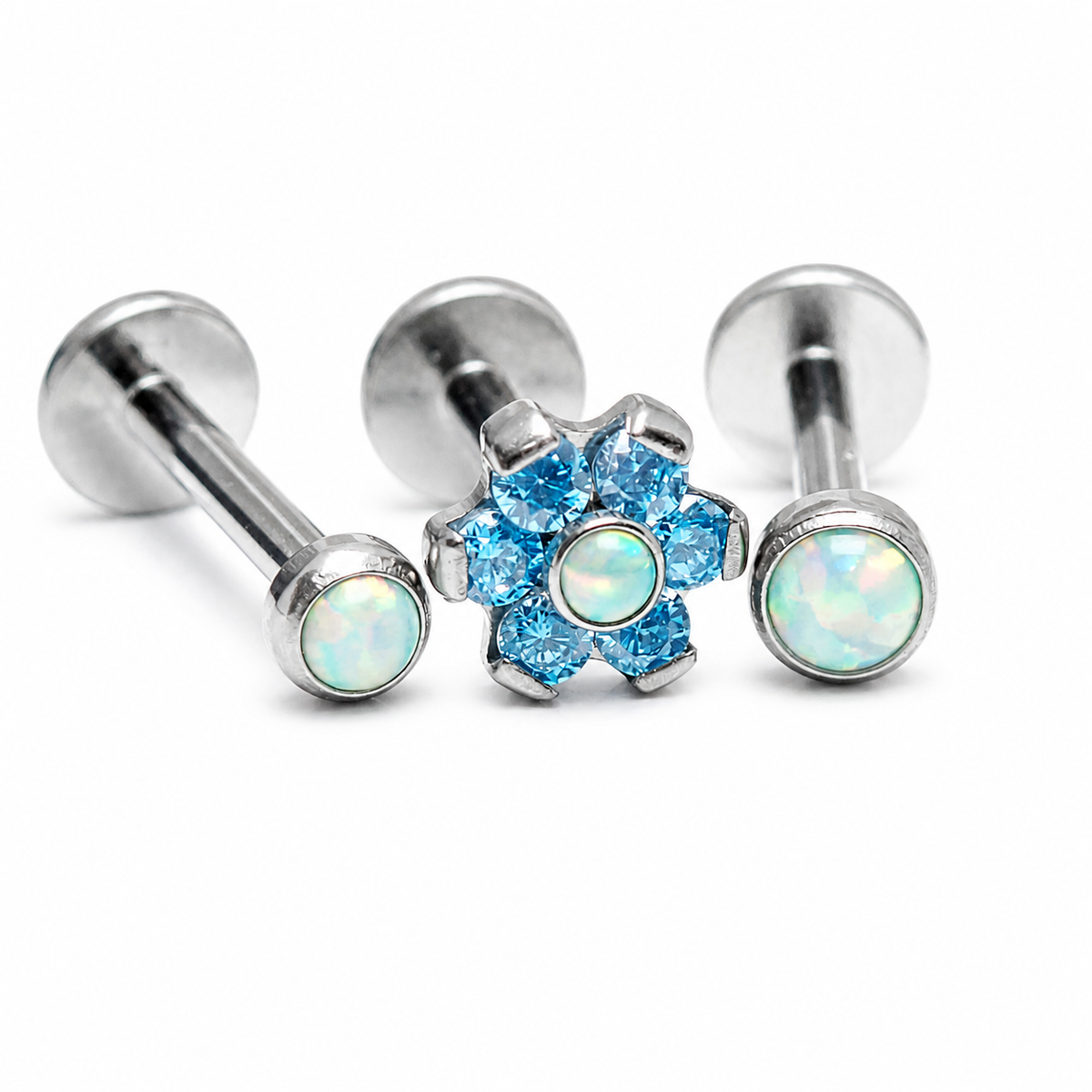
For those building a curated ear, you’ll likely be sticking to 16g posts. Our titanium labret studs are designed with this in mind, offering a secure fit for your 0.9mm threaded tops.
If you’re working on a more "heavy-duty" setup, like a belly ring or an industrial, you’re in the land of 14g. These pieces are bold, statement-making, and require that 1.2mm threading to stay secure through all your daily movements.
BEYOND THE THREAD: THE MAGIC OF ANODIZED TITANIUM
Once you’ve mastered the technical side of 16g vs 14g, it’s time to play with the aesthetics. One of the greatest perks of choosing high-quality titanium is the ability to customize.
At Body Clickers, we offer free anodizing on our titanium pieces. Anodizing isn't a plating or a paint: it’s an electrochemical process that changes the surface layer of the metal to reflect light in different colors.
Want your 1.2mm threaded ends to match your 0.9mm ones? We can anodize them both to the same shade of gold, rose gold, ice blue, or even a mystical "oil slick" rainbow. Check out our Anodizing Color Chart to see the possibilities.
THE BODY CLICKERS COMMITMENT: WHY QUALITY MATTERS
In a world of fast fashion and disposable accessories, your body deserves better. Cheap jewelry often uses external threading (where the screw is on the bar), which can tear up your piercing like a tiny saw blade every time you change it.
By choosing internally threaded jewelry, you are prioritizing your healing and long-term comfort. The smooth post slides through the piercing, and the decorative end is the only thing with threads.
We source our materials directly from US and EU production hubs to ensure you’re getting the real deal. No "mystery metal," no nickel, just pure, body-safe titanium that tells your story.
QUICK COMPATIBILITY RECAP
If you’re still feeling a bit dizzy from the numbers, here is the "cheat sheet" for your next shopping trip:
-
POST SIZE: 18g or 16g
- Thread Size: 0.9mm
- Common for: Helix, Tragus, Conch, Lobes, Nostrils.
- Compatibility: Only fits 0.9mm threaded ends.
-
POST SIZE: 14g or 12g
- Thread Size: 1.2mm
- Common for: Navel, Industrial, Tongue, Nipples, Bridge. Dermal Anchor
- Compatibility: Only fits 1.2mm threaded ends.
- THE OUTLIER: Some specialty posts, like our 14g with 16g hole labrets, are designed specifically to bridge the gap, allowing you to wear delicate 16g ends on a thicker 14g bar.

WEAR YOUR DIFFERENCE
Your piercings are more than just holes in your skin: they are a narrative of who you are, a "refined rebellion" against the mundane. Don't let a technicality like thread size hold back your self-expression.
Whether you’re looking for the ancient symbolism of a moss agate clicker or the sharp, clinical perfection of a high-polish labret, knowing your sizes ensures your journey into body modification is as smooth as our titanium.
BE EXPRESSIVE. BE BOLD. BE YOU.
Ready to upgrade your setup? Explore our latest Adornments and remember: if you’re unsure about your size, our Size Chart is always here to guide you.
#RefinedRebellion #BodyClickers #TitaniumJewelry #PiercingEducation #CuratedEar #AlternativeStyle #JewelryCompatibility